Guerrilla marketing cost in Canada typically ranges from about $5,000 for a simple one-day street activation to $150,000 or more for a multi-city stunt, in our experience. The final price depends on the tactic, city, production, talent, permits and insurance, and how much paid and earned amplification you build around the moment.
Updated November 2026
This is a pricing guide for brand and marketing managers. If you need the fundamentals first, start with our general guide to guerrilla marketing in Canada, then come back here to build your budget.
88% of people trust recommendations from people they know (Nielsen Global Trust in Advertising) · Toronto CMA population ~6.2 million, Canada’s largest urban audience (Statistics Canada 2021 Census) · Brampton population 656,480, one of the GTA’s fastest-growing markets (Statistics Canada 2021 Census)
Guerrilla marketing typically costs $5,000 to $150,000+ in Canada, with most single-city campaigns falling between $15,000 and $60,000. Guerrilla marketing is an unconventional, low-media, high-surprise way of reaching people in public or shared spaces, so the money goes into the idea, the build and the people on the ground.
A full-service quote normally covers concept and creative, design files, fabrication or materials, crew and brand ambassadors, permits and insurance, logistics, photography or video capture, and a wrap report. Some agencies also bundle paid social to amplify the activation after the fact.
The range is wide because guerrilla marketing is not one product. A two-person street team handing out samples near Union Station is a very different job from an overnight 3D installation with a projection layer in three cities. Each extra city, day, performer or custom element adds cost.
Guerrilla tactics often cost less than a full branded pop-up or festival build because they rely on surprise rather than scale. For a wider view of activation pricing, see our experiential marketing cost guide.
Guerrilla marketing cost varies most by tactic. The table below shows typical estimated ranges we see for a single Canadian city, before paid media. Treat them as planning ranges, not quotes.
| Tactic | Typical cost range (CAD) | What drives the price |
|---|---|---|
| Chalk or 3D street art | $3,000 to $20,000 | Artist fees, size, number of pieces, permit for sidewalk use |
| Ambient installations | $8,000 to $50,000 | Custom fabrication, materials, install and removal, site approvals |
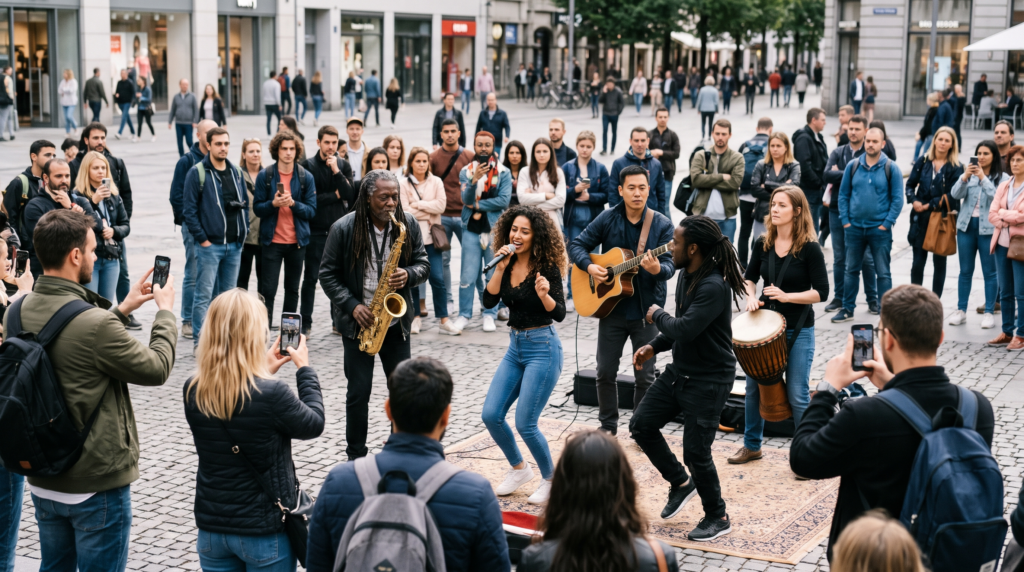
| Flash mob or street performance | $10,000 to $60,000 | Performers, choreography, rehearsals, sound, crowd management |
| Publicity stunts | $20,000 to $150,000+ | Concept complexity, props, safety planning, PR outreach |
| Projection mapping | $10,000 to $80,000 | Content production, projectors, power, building owner consent |
| Guerrilla pop-up | $15,000 to $100,000 | Structure, space rental, staffing days, product or samples |
| Street teams | $2,500 to $25,000 | Team size, hours, wardrobe, collateral, sampling permits |
Street art and projection often deliver the most reach per dollar, because they are highly photographable and spread on social. A strong visual that people want to film can outperform a more expensive stunt that nobody shares.
Street teams and guerrilla pop-ups are best when you need hands-on contact, product trial or sign-ups. They cost more per day in labour but produce trackable, one-to-one interactions.
The cost of a guerrilla campaign is driven mainly by creative complexity, production, people, locations and time. Media is usually a smaller line than buyers expect.
Concept development typically represents 10 to 20 percent of a guerrilla budget in our experience. A sharp idea is the whole point of guerrilla marketing, so this is not the place to cut. Expect concept boards, a site plan and a run of show.
Production is usually the largest cost. Custom props, oversized installations, weatherproof materials and safe rigging all add up. Canadian weather also matters: a November activation in Toronto or Ottawa needs materials and staffing plans that a July event in Vancouver might not.
Brand ambassadors, performers, artists, team leads and security are billed by the hour or day. Rehearsals, travel and overtime can quietly double a talent line, so ask for them to be itemised.
Yes. Dense, high-footfall areas such as downtown Toronto, the Distillery District, Yonge-Dundas, Gastown in Vancouver or Old Montreal tend to carry stricter rules, longer approvals and higher logistics costs than suburban plazas in Mississauga, Brampton or Markham.
Each extra day adds crew, permits and site costs, though concept and fabrication are spread across more days. Multi-day or multi-city runs usually lower the cost per engagement even as the total rises.
Permits and insurance are required costs for almost any guerrilla activity that uses public space in Canada. Legal, permitted tactics protect your brand and your budget; illegal postering, unapproved stickers, paint on public property or any form of vandalism can lead to fines, removal costs and reputational damage that wipe out any gain.
Depending on the tactic, a campaign may need a street or sidewalk use permit, a special event permit, a park permit, a filming permit or sampling approval. In Toronto, for example, the City issues permits for many uses of streets, sidewalks and public spaces, and other Canadian cities have similar processes. Requirements and fees change, so always confirm with the municipality directly.
Simple permits can take a couple of weeks, while larger activations, road occupancy or park use can take a month or more. Build the timeline backwards from your launch date and leave room for revisions.
Most cities and private property owners ask for commercial general liability insurance and a certificate naming them as additional insured. Liability coverage is typically arranged by your agency, but confirm limits and who holds the policy before you sign.
Plazas, malls, transit spaces and building facades are often privately owned or managed. You need written consent from the owner or manager, and projection onto a building always needs the owner’s permission.
These sample guerrilla marketing budgets show how a typical spend might break down in Canada. They are estimates based on the kinds of campaigns we scope, not fixed prices.
| Line item | Small (1 city, 1 day) | Mid-size (1 to 2 cities, 3 days) | Large (3+ cities, multi-week) |
|---|---|---|---|
| Concept and creative | $1,500 | $6,000 | $20,000 |
| Production and materials | $3,000 | $15,000 | $60,000 |
| Talent and staffing | $2,000 | $10,000 | $35,000 |
| Permits and insurance | $800 | $3,000 | $10,000 |
| Logistics and travel | $700 | $3,000 | $15,000 |
| Content capture | $1,000 | $4,000 | $12,000 |
| Paid amplification | $1,000 | $5,000 | $20,000 |
| Estimated total | about $10,000 | about $46,000 | about $172,000 |
A small campaign might be a permitted 3D sidewalk piece outside a retail location in Toronto with a two-person crew driving people to scan a QR code. It suits a local launch or a test before investing more.
A mid-size campaign could pair a street performance with a street team across downtown Toronto and Mississauga over a weekend, with a photographer and paid social to extend the reach.
A large campaign might roll a stunt or ambient installation through Toronto, Montreal and Vancouver over several weeks, with PR outreach, bilingual creative for Quebec and a dedicated content team.
Guerrilla marketing ROI is measured by comparing the total campaign cost against the outcomes you set before launch, such as engagements, leads, earned media or sales. Because guerrilla tactics happen offline, you need to build tracking into the creative itself.
There is no universal benchmark; it depends on how deep the interaction is. A quick photo moment costs less per engagement than a full product demo, but the demo is usually worth more. Compare against your other channels rather than a generic number.
Guerrilla campaigns are designed to be talked about, and personal recommendation is powerful: Nielsen reports that 88% of people trust recommendations from people they know. For ongoing industry benchmarks on live and experiential marketing, Event Marketer is a useful resource.
You can stretch a guerrilla marketing budget by investing in one strong idea, reusing assets and placing the activation where your audience already gathers.
Spend on the idea first. A simple, clever concept executed well usually outperforms an expensive build with a weak hook, and it is far easier to permit.
Shoulder seasons can mean easier approvals and better crew availability. Riding existing foot traffic, such as a sports weekend or a busy shopping period, also delivers more eyes without extra media spend.
Use data to pick neighbourhoods that match your audience. Statistics Canada census data, for example, shows the Toronto CMA at roughly 6.2 million people and Brampton at 656,480, which helps you size reach and choose between downtown and suburban sites.
Yes. Design props and installations to travel, and capture strong photo and video so the activation keeps working as paid social, case content and sales material long after the day itself.
Brand Guruz, a Toronto-based experiential marketing agency, plans and produces guerrilla and street-level campaigns across the GTA and Canada. We combine creative concepting, production, permitting support, staffing and measurement under one team, so you get one accountable partner and one clear budget.
We only run legal, permitted tactics, and we build tracking into every activation so you can see what your spend delivered. Explore our experiential marketing services, compare us against the best experiential marketing agencies in Canada, or contact Brand Guruz for a scoped estimate.
In our experience, a guerrilla marketing campaign in Canada typically costs between $5,000 and $150,000 or more. A one-day chalk art or street team activation in a single city often sits at the low end, while multi-city stunts with custom builds, projection and paid amplification sit at the high end. Scope, city, talent and permits drive the final figure.
Guerrilla marketing is often cheaper per impression than traditional media when the idea earns press and social sharing, but it is not automatically cheap. Production, permits, insurance and staffing are real costs. The savings come from earned reach: a clever, permitted activation can travel far beyond the people who see it in person.
Usually, yes. Most Canadian cities, including Toronto, require permits for activity that uses sidewalks, streets, parks or other public space, such as sampling, sidewalk art, staging or filming. Rules and fees vary by city and by activity, so confirm requirements with the municipality well before launch. Brand Guruz only runs permitted, legal tactics.
Street teams and temporary chalk or washable sidewalk art are typically the most affordable guerrilla tactics, often starting around a few thousand dollars for a single day in one city. The low cost assumes a simple creative, a small crew and a permitted location. Costs rise quickly once you add custom builds, performers or multiple cities.
Measure guerrilla marketing ROI by setting one primary goal, then tracking the metrics tied to it: in-person engagements, QR scans, promo code redemptions, sign-ups, social mentions, earned media and sales lift in the activation area. Compare the total cost against those outcomes to find cost per engagement or cost per lead.
Plan at least six to ten weeks ahead for a mid-size guerrilla campaign in Canada. That window covers creative development, municipal permit applications, insurance certificates, fabrication and staffing. Large or multi-city stunts often need three months or more, and summer and festival season dates book up early in cities like Toronto.

Ready to price a guerrilla campaign that people talk about for the right reasons? Tell us your goal, city and timing, and we will come back with a clear, itemised estimate and a permit plan. Start the conversation through our contact page.