Red Envelopes and Brand Loyalty: The Canadian Guide to Lunar New Year Marketing

Lunar New Year marketing in Canada is not a single-day campaign opportunity. It is a 15-day cultural activation window that opens in the first week of February. The window runs through the Lantern Festival on March 3, 2026. Specifically, Lunar New Year 2026 falls on February 17 — the Year of the Horse. It reaches Chinese Canadian, Vietnamese Canadian, Korean Canadian, and Southeast Asian communities simultaneously. Statistics Canada’s 2021 Census puts Chinese Canadians alone at approximately 1.7 million nationally. Consequently, brands that plan Lunar New Year marketing in Canada correctly target several GTA communities at once. They are reaching several of the GTA’s most commercially significant multicultural consumer audiences in a single activation season.

The commercial window is also longer than most brands realize. Specifically, the two weeks before Lunar New Year — February 3 through 16 — are the highest-spending period in the Lunar New Year marketing cycle. New clothing, gift purchases, fresh food for reunion dinners, home décor, and red envelope cash are all sourced before the New Year arrives. Brands that launch Lunar New Year marketing in Canada on February 17 have already missed the purchase intent window.

This guide covers who celebrates Lunar New Year in Canada, the key spending categories, the activation calendar, and the mistakes that cost brands community trust. For the community profile that underpins this guide, see our Chinese Canadian consumer guide. The full 2026 cultural occasions calendar is in our Canadian multicultural events calendar.

February 17

 Lunar New Year 2026 (Year of the Horse), with the commercial window opening February 3

1.7M+

Chinese Canadians alone, the largest single community observing Lunar New Year in Canada (Statistics Canada)

15

days in the full Lunar New Year festival, from New Year’s Day through the Lantern Festival on March 3, 2026

Why Lunar New Year marketing in Canada is a 15-day brand opportunity

No other multicultural occasion in the Canadian calendar offers brands a 15-day sustained activation window. Specifically, Lunar New Year begins on February 17 and runs through the Lantern Festival on March 3. Each segment of the festival carries distinct commercial activity — pre-New Year shopping, reunion dinner feasting, gifting, community celebrations, and the final Lantern Festival. Brands that treat Lunar New Year marketing in Canada as a one-week campaign leave two weeks of consumer engagement unreached.

Furthermore, Google Canada research confirms that multicultural consumers significantly over-index on peer recommendations and in-community media during cultural occasions. Lunar New Year generates the highest peer sharing and community conversation of the year across Chinese Canadian, Vietnamese Canadian, and Korean Canadian calendars. Brands with authentic in-community presence during this window earn community trust that digital campaigns cannot replicate.

Additionally, Lunar New Year marketing in Canada benefits from a strong commercial tradition that consumers expect brands to participate in. Specifically, Lunar New Year brand activations — red envelope programs, zodiac-themed campaigns, in-store celebrations — are established consumer expectations in Chinese Canadian communities. Brands that show up authentically are welcomed. For the broader multicultural activation framework, see our multicultural market research guide.

Who celebrates Lunar New Year in Canada and what it means for brand marketing

Lunar New Year in Canada reaches a broader consumer base than the Chinese Canadian community alone. Specifically, Vietnamese Canadians observe Tết on the same date — following the same lunar calendar. Korean Canadians observe Seollal. Additionally, Singaporean, Malaysian, Taiwanese, and Thai Canadian communities all observe Lunar New Year with distinct but overlapping cultural traditions.

Geographically, Lunar New Year marketing in Canada concentrates most heavily in Markham and Richmond Hill. Both cities hold the highest Chinese Canadian consumer concentrations in the country. Specifically, Pacific Mall in Markham is one of the largest indoor Asian malls in North America. It becomes the commercial heart of GTA Lunar New Year celebrations. Scarborough’s Vietnamese Canadian community centres around the Agincourt corridor. North York holds significant Korean Canadian and Cantonese-speaking Chinese Canadian populations. Additionally, downtown Toronto’s Chinatown on Dundas Street hosts major public celebrations.

Moreover, the Lunar New Year community in Canada spans two distinct linguistic groups — Mandarin-speaking and Cantonese-speaking Chinese Canadians. Specifically, these two communities observe the same occasion through different cultural lenses, consume different media, and communicate through different platforms. Mandarin-speaking consumers, concentrated in Markham and Richmond Hill, are heavy WeChat users. Cantonese-speaking consumers, concentrated in Scarborough and North York, engage more actively with Cantonese-language digital and broadcast media. Effective Lunar New Year marketing in Canada addresses both groups through separate language channels. See our Chinese Canadian consumer guide for the full community profile.

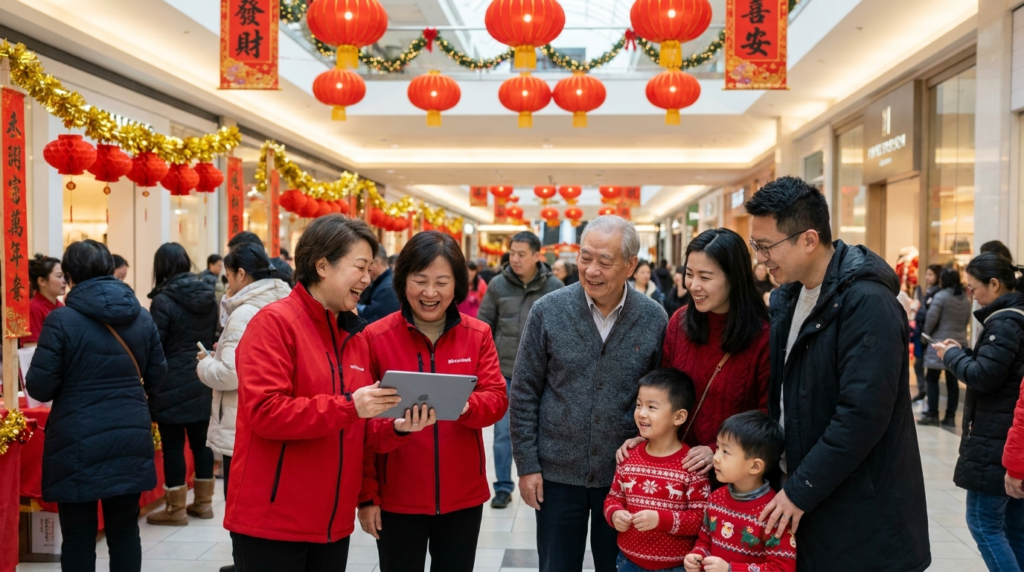
Lunar New Year marketing Canada 2026: brand ambassador team engaging with Chinese Canadian families at a Lunar New Year activation in Markham, Ontario.
The most commercially significant Lunar New Year marketing in Canada happens before February 17 — in the two-week pre-New Year shopping window when gift, food, and clothing purchases peak across Markham, Richmond Hill, and Scarborough.

Lunar New Year marketing in Canada: spending patterns and brand opportunities

The pre-New Year spending surge begins approximately two weeks before Lunar New Year. It represents the highest-intensity commercial window in the Lunar New Year marketing cycle. Specifically, food and grocery spending leads this surge. T&T Supermarket and independent Chinese and Vietnamese grocers see their highest annual sales in the week before Lunar New Year. Reunion dinner ingredients, premium packaged foods, oranges and tangerines (given for luck), and specialty Lunar New Year products drive significant pre-holiday basket sizes.

Gifting is the second major spending driver. Specifically, red envelopes — hongbao in Mandarin, lai see in Cantonese — filled with cash are given by elders to children and unmarried adults. Brands that run digital red envelope programs or offer hongbao-themed gift products earn strong community goodwill. Additionally, premium gift boxes — dried goods, premium teas, health supplements, and packaged sweets — are purchased and given throughout the celebration period.

New clothing is a near-universal Lunar New Year tradition — wearing new clothes on New Year’s Day is considered auspicious. Specifically, clothing, personal care, and fashion retailers that acknowledge Lunar New Year reach Chinese Canadian, Vietnamese Canadian, and Korean Canadian consumers at peak purchase intent.

Furthermore, gold and jewellery purchases concentrate in the days before Lunar New Year, mirroring the auspicious spending traditions seen at Diwali. Financial services brands that frame new savings accounts and investment products around prosperity and new beginnings perform strongly. The Lunar New Year marketing window is one of the most receptive moments for financial decision-making in the year. For the brand activation framework that applies, see our festival brand activation playbook.


The Lunar New Year marketing calendar for brands in Canada

February 3–16: Pre-New Year commercial peak The two weeks before Lunar New Year are the most commercially intensive period of the Lunar New Year marketing cycle in Canada. Specifically, consumers are shopping for reunion dinner groceries, buying gifts and red envelopes, purchasing new clothing, and decorating homes. Brands present in Markham, Richmond Hill, and Scarborough during this window reach consumers at peak purchase intent. In-language digital content and ambassador activations are the key formats.

February 17: New Year’s Day New Year’s Day is primarily a family occasion — reunion dinners, lion dances, temple visits, and community celebrations. Specifically, public celebrations in Markham and downtown Toronto draw large community crowds. Brand activations at community events on New Year’s Day earn high visibility. See our brand ambassador program guide for the on-ground staffing model.

February 18–28: First week of celebrations Community events, cultural performances, and social gatherings continue through the first week. Specifically, this is the highest-engagement period for in-language social content and WeChat-based brand campaigns for Mandarin-speaking Chinese Canadian consumers.

March 3: Lantern Festival The Lantern Festival closes the 15-day celebration. Specifically, sweet rice dumplings (tangyuan) and lantern events define this final occasion. Brands that acknowledge the Lantern Festival signal an unusual depth of Lunar New Year cultural knowledge.

What effective Lunar New Year marketing in Canada looks like

The Edelman Trust Barometer consistently confirms that community trust builds through authentic, sustained presence rather than broadcast advertising. Lunar New Year marketing in Canada succeeds on exactly this foundation.

Specifically, effective Lunar New Year marketing in Canada uses the correct year animal — the Horse for 2026 — in all campaign creative. Using the wrong zodiac animal signals that a brand has not engaged with the occasion. Additionally, red and gold are the appropriate colour palette. White and black are associated with mourning and should not appear in Lunar New Year creative.

Moreover, effective Lunar New Year marketing in Canada is in-language. Specifically, Mandarin-language content reaches Mainland Chinese-origin consumers in Markham and Richmond Hill. Cantonese-language content reaches Hong Kong-origin consumers in Scarborough and North York. Vietnamese-language content reaches Tết-observing consumers in Scarborough’s Vietnamese Canadian community. A single English-language Lunar New Year campaign reaches none of these communities authentically.

Additionally, WeChat is the primary peer-recommendation and brand-discovery platform for Mandarin-speaking Chinese Canadian consumers. Brands without a WeChat presence miss the dominant community information channel during the highest-engagement two weeks of the year. For the in-language Lunar New Year ambassador model, see our multicultural brand ambassador guide and experiential marketing agency Toronto overview.

Common mistakes brands make in Lunar New Year marketing in Canada

The most common mistake is calling it “Chinese New Year” when marketing across the full range of Lunar New Year communities. Specifically, Vietnamese Canadians observing Tết and Korean Canadians observing Seollal do not identify with “Chinese New Year” as a description of their own occasion. “Lunar New Year” is the inclusive and accurate term for Lunar New Year marketing in Canada that seeks to reach all observing communities.

The second mistake is using the wrong zodiac animal. Specifically, every Lunar New Year campaign creative that references the zodiac must use the correct year’s animal. Year of the Horse creative in a Year of the Snake year signals that a brand has recycled past campaigns — immediately damaging community credibility.

The third mistake is a narrow activation window. Specifically, brands that activate only on February 17 miss both the pre-New Year commercial peak and the 14 remaining festival days. The highest purchase intent occurs before the New Year, not on the day itself.

Finally, brands consistently underinvest in WeChat. Specifically, Mandarin-speaking Chinese Canadian consumers in Markham and Richmond Hill discover and share brand content primarily through WeChat groups. Instagram, Facebook, and X are secondary channels for this community. A Lunar New Year marketing program in Canada without a WeChat strategy misses the most commercially significant digital channel in the Mainland Chinese Canadian community.

Frequently asked questions about Lunar New Year marketing

When is Lunar New Year 2026 and how long does it run? Lunar New Year 2026 falls on February 17 — the Year of the Horse. The full festival runs 15 days, from New Year’s Day through the Lantern Festival. Brands should expect peak commercial activity from approximately February 3 through the first week of celebrations.

Which communities observe Lunar New Year in Canada? Chinese Canadians, Vietnamese Canadians, Korean Canadians, and Southeast Asian communities all observe Lunar New Year. Specifically, Chinese Canadians number approximately 1.7 million nationally, followed by Vietnamese and Korean Canadians.

What spending categories perform best during Lunar New Year in Canada? Food and grocery, gifting and red envelopes, clothing, jewellery and gold, financial services, and home décor all perform strongly. The pre-New Year window — February 3 to 16 — is the highest-spending period of the cycle.

What role does WeChat play in Lunar New Year marketing in Canada? WeChat is the dominant peer-recommendation and brand-discovery platform for Mandarin-speaking Chinese Canadian consumers in Markham and Richmond Hill. Community group chats, brand hongbao programs, and promotional content spread through WeChat at high velocity during Lunar New Year. Lunar New Year marketing in Canada without a WeChat presence misses the most commercially significant digital channel for Mainland Chinese-origin consumers.

What cultural details should brands get right in Lunar New Year creative? Specifically, use the correct Year of the Horse zodiac in all 2026 creative. Use red and gold — not white or black. Always use “Lunar New Year” rather than “Chinese New Year” for inclusive reach across all observing communities. Additionally, lucky numbers matter in Lunar New Year marketing. Amounts of $8, $88, and $888 carry positive cultural resonance.

Build your Lunar New Year marketing program in Canada with Brand Guruz

Talk to Brand Guruz about building a Lunar New Year marketing program in Canada. We cover in-language Mandarin, Cantonese, and Vietnamese activations across Markham, Richmond Hill, and Scarborough. Ambassador teams who share the culture run every activation from pre-New Year through the Lantern Festival.

Author