Bell, Rogers, and Telus added fewer than 54,000 net new mobile subscribers in Q1 2025 — their weakest result in four years. Quebecor, the parent company of Freedom Mobile, Videotron, and Fizz, added 54,400 in the same quarter alone. One group of carriers outperformed the other by the precise margin that separates community-driven marketing from volume-dependent growth. Telecom marketing in Canada has never been so important.
Overall, the Big 3 had built their subscriber expansion on Canada’s immigration pipeline. In 2022, Canada’s population grew by 3.1% — the highest rate since the 1950s. Hundreds of thousands of newcomers signed up for new phone plans. Indeed, when the federal government cut immigration targets by approximately 20%, that subscriber pipeline contracted sharply. Consequently, the entire acquisition model underpinning years of wireless growth became exposed overnight.
Specifically, the carriers that outperform in telecom marketing in Canada are not those with the largest advertising budgets. Community presence wins. They are the ones with genuine multicultural community relationships — built through experiential marketing and culturally fluent ambassador programs.
Brand Guruz runs multicultural experiential marketing programs across Ontario’s South Asian, East Asian, Caribbean, and Filipino communities. Our work in this space directly addresses the marketing challenge Canadian telecom brands face in 2026.
net new mobile subscribers for Bell, Rogers, and Telus combined in Q1 2025 — the lowest in four years (Bloomberg)
the size of Canada’s telecom market in 2026, growing at a 4.65% CAGR (Mordor Intelligence)
of total Canadian telecom revenues accounted for by the four largest providers (CRTC 2025)
Canada’s telecom market is worth $52.28 billion in 2026, growing at a CAGR of 4.65%. However, that headline growth masks a more complicated picture at the subscriber level.
The Big 3 account for 85.6% of total Canadian telecom revenues, per the CRTC’s 2025 market report. Overall, their dominance historically rested on two pillars: network investment and newcomer-driven subscriber volume. Indeed, from 2020 to 2023, Canadian operators gained 4.6 million subscribers and $4.6 billion more in revenue — tracking with Canada’s high immigration rates.
Specifically, the federal immigration reductions for 2025 and 2026 removed the growth lever the Big 3 had counted on most. RBC noted that carriers are shifting from acquisition to retention — a fundamental pivot with direct implications for telecom marketing in Canada.
Furthermore, Quebecor’s Q1 2025 performance showed that community-oriented, value-driven marketing captures subscriber growth even when the Big 3 are standing still. Freedom Mobile and Videotron’s combined 54,400 net adds against the Big 3’s combined total is a clear competitive signal.
The immigration-driven acquisition model assumed that volume would carry the day. Carriers could rely on a constant stream of new arrivals each needing a phone plan. Consequently, carriers consistently underfunded multicultural subscriber retention relative to their acquisition spend.
Specifically, that imbalance is now a liability. South Asian communities in Brampton, Mississauga, and Markham represent one of the largest subscriber segments in the GTA. Chinese-Canadian communities in Richmond Hill, Markham, and North York are highly active switchers when pricing or service quality disappoints. Moreover, Caribbean-Canadian communities make carrier decisions through community recommendation networks — faster and more influential than any digital retargeting campaign. Filipino-Canadian communities across the GTA have similar dynamics.
In all of these communities, one principle holds: community presence builds stickier trust than a promotional offer ever does. A family that meets a carrier’s ambassador at three consecutive community festivals will not switch over a $5-per-month pricing difference. Ultimately, community presence converts to loyalty. Overall, that is the retention value that experiential marketing generates — and that no amount of display advertising replicates.
Moreover, an RBC survey found approximately 35% of Canadians are unlikely to switch providers. Consequently, satisfaction is the primary driver of loyalty. The subscribers most likely to stay loyal are those with a relational brand connection — not just a promotional history. For this audience intelligence framework, see our multicultural market research guide.
Effective telecom marketing in Canada operates through several event formats — each suited to a different community segment and subscriber relationship stage.
South Asian community events — Brampton melas, Diwali festivals, temple-adjacent events, Carassauga, and regional cultural celebrations — reach the GTA’s largest visible minority segment in an environment where community trust transfers directly to brand affinity. Specifically, a carrier that fields Punjabi-speaking ambassadors earns credibility that a digital ad cannot match.
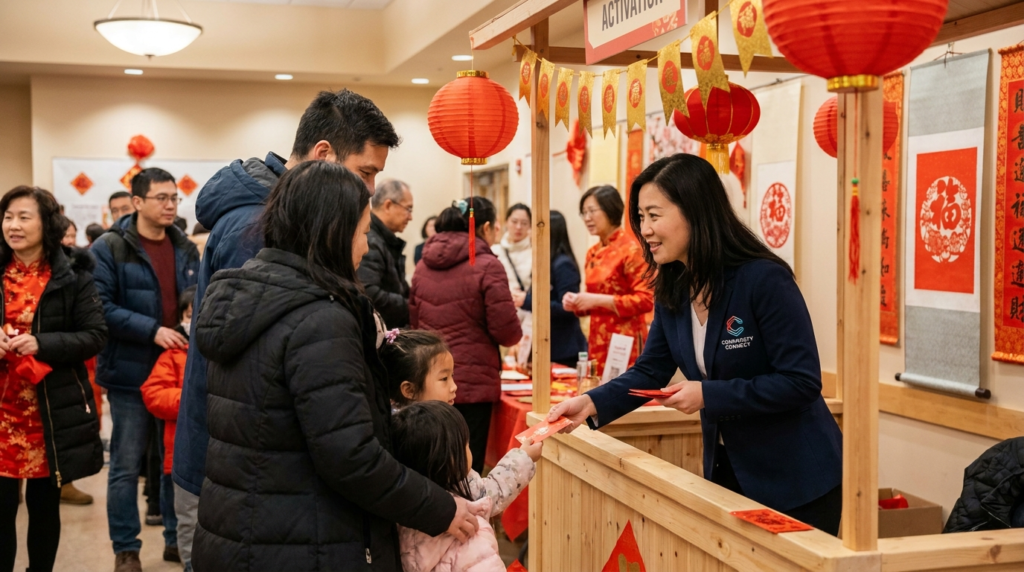
East Asian community events — Lunar New Year celebrations, Mid-Autumn festivals, Chinese-Canadian business association gatherings, and community events across Markham and Richmond Hill — reach a subscriber segment that makes carrier decisions through trusted peer networks. Furthermore, carriers that sponsor meaningful cultural moments — rather than simply advertising during them — demonstrate a qualitatively different level of investment.
Caribbean and Filipino community activations — community events for Caribbean-Canadian audiences across East Toronto and North York, and church-based events for Filipino-Canadian communities — reach subscriber segments mainstream telecom marketing consistently underserves.
Pop-up activations at cultural retail destinations — Pacific Mall in Markham, the Gerrard India Bazaar, Brampton’s South Asian commercial corridors — place brand teams in high-footfall multicultural environments where carrier switching decisions are made in person, not online. Generally, a culturally fluent pop-up at Pacific Mall generates more qualified subscriber conversations per hour than a week of digital retargeting.
Despite the reduction in newcomer volumes, Canada still receives hundreds of thousands of permanent residents each year. Additionally, those who do arrive represent a concentrated acquisition opportunity. Newcomers typically make carrier decisions within their first ninety days. The carrier they choose first often retains them for years.
The challenge for Canadian carriers is reaching newcomers before competitors do. Ultimately, the window between arrival and first plan selection is the highest-value moment in the entire subscriber lifecycle. Carriers present at newcomer gatherings and community centre programming reach prospective subscribers at the precise moment they are most receptive.
In particular, in-language ambassador staffing is critical at this stage. A newcomer who encounters a brand ambassador who speaks their language forms a different relationship with that carrier. One who only encounters a translated English-language flyer does not. For the brand ambassador staffing capability that supports newcomer acquisition events, see our brand ambassador program guide.
Brand Guruz runs multicultural experiential marketing programs across Ontario’s South Asian, East Asian, Caribbean, and Filipino communities. These are precisely the primary multicultural subscriber segments for Canadian telecom brands.
Specifically, our track record across Caribana, WorldFest, and Carassauga means our teams are embedded in communities where carrier decisions are made. They bring existing community credibility. That is the kind effective telecom marketing in Canada requires — not a first-time introduction at an activation.
Furthermore, our team builds telecom-specific ambassador programs with in-language staffing across Punjabi, Tamil, Tagalog, Cantonese, and Mandarin. This allows carriers to have genuine conversations at community events rather than relying on generic English-language pitches. For the experiential marketing measurement framework that applies across telecom acquisition and retention programs, see our experiential marketing ROI guide.
Additionally, Brand Guruz coordinates the full event chain — permit applications, production, and on-site management — for festival presence and community events. For the broader experiential capability that underpins our telecom multicultural programs, see our festival brand activation playbook.
Why does multicultural community marketing matter more for Canadian telecoms in 2026? The immigration-driven newcomer pipeline has contracted significantly following federal immigration reductions for 2025 and 2026. The industry has shifted from customer acquisition to retention as its primary strategic focus. Consequently, multicultural communities already in Canada have become the primary retention battleground for carriers.
What types of events work best for telecom multicultural marketing? The most productive formats position the carrier as a genuine community participant. South Asian festivals, Lunar New Year events, and Caribbean and Filipino community gatherings allow for in-language engagement that generates authentic subscriber relationships. Additionally, pop-up activations at Pacific Mall and the Gerrard India Bazaar deliver high-footfall subscriber conversations in environments where switching decisions are actively made.
How does experiential telecom marketing affect subscriber retention? Community-based marketing builds brand relationships that are qualitatively different from those formed through promotional offers. Subscribers who experience a carrier as a genuine community participant demonstrate significantly higher loyalty than those acquired through promotion alone. Specifically, the churn differential is most pronounced in communities where recommendations travel through tight social networks.
What in-language capabilities does telecom community marketing require? Effective telecom community marketing requires ambassador teams with genuine language capability in Punjabi, Tamil, Tagalog, Cantonese, and Mandarin — the dominant languages across South Asian, Filipino, and East Asian GTA communities. Generic bilingual staffing is insufficient for most multicultural telecom activations. Cultural fluency matters as much as language. Ambassadors who understand community context produce better engagement than those with language skills alone.
Does Brand Guruz work with Canadian telecom brands on multicultural marketing programs? Yes. Brand Guruz works with brands across Ontario’s entertainment, hospitality, and telecommunications sectors on multicultural experiential marketing programs. Our telecom-specific capability covers South Asian, East Asian, Caribbean, and Filipino community activations — in-language staffing and full event coordination.

Talk to Brand Guruz about experiential marketing for your Canadian telecom brand — multicultural community activations, in-language ambassador programs, and newcomer acquisition events. See also our experiential marketing company Toronto page for the full capability picture.