Trade Show Display Ideas: 25 Booth Concepts That Pull Visitors In (2026)

The best trade show display ideas combine a clear headline visible from 10 metres away, an open layout that invites people in, and one interactive moment that starts a conversation. Pick concepts that match your goal, whether that is leads, demos or awareness, and staff them with trained people who qualify visitors fast.

Updated November 2026

Key takeaways

  • A trade show display is the physical and digital set-up that turns an empty booth space into a branded, working sales environment.
  • Lead with one seven-word message and big visuals; visitors decide in seconds whether to stop.
  • Interactive and experience ideas outperform static graphics because they give staff a natural opening line.
  • A 10×10 booth can compete with an island if it uses height, light and a single strong hook.
  • Match every idea to a goal and a measurement plan before you spend a dollar on build.

Below are 25 booth concepts grouped by type, each with what it is, why it works and a rough cost tier. Cost tiers are typical estimates in Canadian dollars per show, based on our experience: $ under $1,000, $$ $1,000 to $5,000, $$$ $5,000 to $20,000, $$$$ over $20,000.

88% of people trust recommendations from people they know, the core reason face-to-face selling works (Nielsen Global Trust in Advertising) · ~6.2 million people live in the Toronto CMA, Canada's largest trade show market (Statistics Canada 2021 Census) · 543,551 people live in the London CMA and 575,847 in Kitchener-Cambridge-Waterloo, two growing Ontario show markets (Statistics Canada 2021 Census)

What makes a trade show display work?

A trade show display works when it stops the right people, earns a conversation and captures a qualified lead. Everything else, from fabric to flooring, should serve those three jobs.

What do visitors notice first?

Visitors notice height, light and one bold message first. Most attendees scan an aisle while walking, so a headline placed above two metres, with high contrast and fewer than eight words, does more work than a wall of copy at eye level.

Why does face-to-face still matter?

Face-to-face contact builds trust faster than any digital channel. Nielsen research shows 88% of people trust recommendations from people they know, and a well-staffed booth is one of the few places a buyer meets your team before a sales call. Your display exists to start that human moment.

If you are still planning the structure itself, our guide to the trade show booth design process covers briefs, renderings and approvals. This article focuses on the ideas you can layer on top.

Structural and layout display ideas

1. Open-front layout with a pulled-back counter

Move the reception counter to the back third of the booth and leave the aisle edge completely open. An open threshold removes the psychological barrier of stepping into a sales space, so more people drift in. Cost tier: $ (layout change only)

2. Tower or hanging sign

A tall fabric tower or a rigged overhead sign carries your logo above the crowd. It makes you findable from across the hall, which matters at large convention centres in Toronto, Mississauga or Vancouver. Cost tier: $$ to $$$ (rigging fees vary by venue)

3. Double-deck or raised platform

A second level or a low stage lifts demos and meetings above floor traffic. Height signals scale and creates a private meeting area without losing floor space. Cost tier: $$$$

4. Modular backwall system

Interlocking frames with swappable graphics that reconfigure from 10×10 to 10×20. One investment serves several shows and booth sizes, so cost per show falls over a season. Cost tier: $$ to $$$

5. Product-as-architecture

Build the booth out of your product: pallets of packaging, stacked equipment or oversized replicas. Visitors understand what you sell before reading a word, which shortens every conversation. Cost tier: $$ to $$$$

Before you buy any structure, compare ownership with trade show booth rental in Canada; renting a modular system is often smarter for brands doing fewer than three shows a year.

Interactive and tech display ideas

6. Touchscreen product kiosk

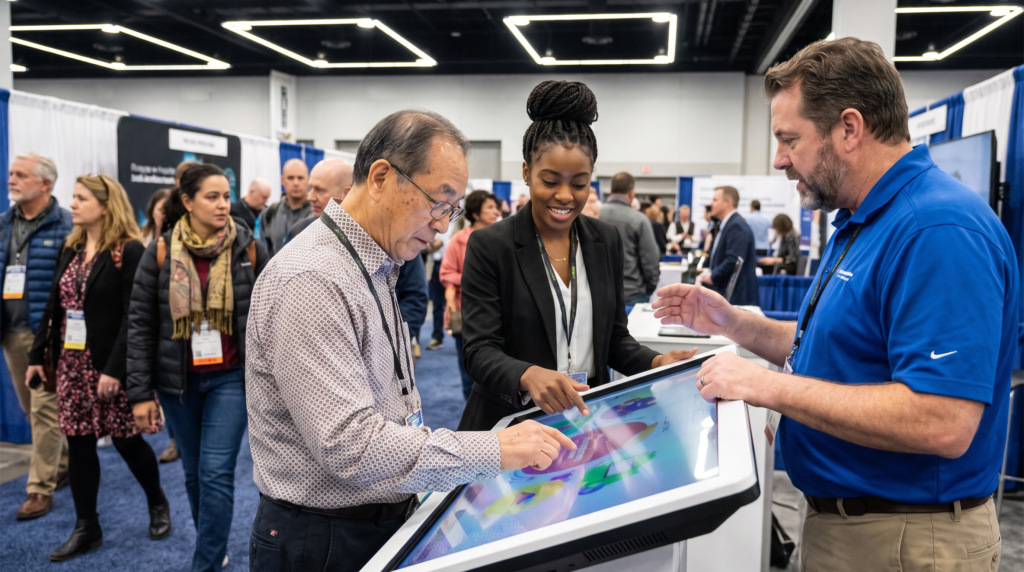
A self-serve screen with product configurators, spec sheets and a lead form. It answers basic questions while staff are busy, and it captures contact details at the moment of interest. Cost tier: $$

7. Live data or social wall

A large display showing real-time stats, a product dashboard or moderated social posts. Motion attracts the eye, and live content proves your product works rather than describing it. Cost tier: $$ to $$$

8. AR or VR product demo

Headsets or tablets that let buyers walk through a facility, a machine or a finished space. It solves the problem of products too large, expensive or complex to ship to the floor. Cost tier: $$$

9. Gamified quiz with a leaderboard

A two-minute quiz on a tablet tied to your category, with the top score winning a prize. Competition creates crowds, and crowds attract more crowds; each entry is a qualified lead with answers you can segment. Cost tier: $ to $$

10. QR-triggered personalised follow-up

Each demo station has a QR code that sends the visitor the exact resource they just saw. Follow-up arrives while interest is high, and you learn which demo drives the most engagement. Cost tier: $

Trade show display ideas: interactive touchscreen kiosk capturing leads at an exhibitor booth
An interactive touchscreen kiosk lets visitors self-serve product info while staff capture leads.

Engagement and experience ideas

11. Booth lounge for seated conversations

A small lounge zone with soft seating, charging points and water. Tired attendees stay longer, and a seated conversation is far more likely to become a real sales discussion. Cost tier: $$

12. Scheduled live demos

Short demos at posted times, promoted on a sign and in pre-show emails. Fixed times create mini-events that pull people in at once, and staff can plan their energy around them. Cost tier: $ to $$

13. Barista or signature drink station

A coffee bar or a branded mocktail station, especially strong on morning show days. It gives visitors a reason to wait two minutes, and that wait is a natural window for a conversation. Cost tier: $$ to $$$

14. Hands-on product trial

Let people touch, taste, test or break the product in a controlled way. Physical interaction makes features memorable, and it is the core idea behind good experiential marketing. Cost tier: $ to $$

15. Expert office hours

Book a technical lead or product manager for 20-minute consultations visitors can reserve. Serious buyers self-select, and your team spends time on people who are ready to talk specifics. Cost tier: $

16. Photo moment with a branded backdrop

A well-lit, Instagram-ready set built around your product or campaign line. Visitors share it, extending reach beyond the hall, and it works for consumer and B2B shows alike. Cost tier: $$

Trade show display ideas: booth lounge with live product demo and seated visitors
A lounge zone paired with a live demo keeps qualified visitors in the booth longer.

Lighting, graphics and branding ideas

17. Backlit fabric (SEG) graphics

Silicone-edge fabric panels lit from behind by LED light boxes. Colours stay rich under harsh hall lighting, and the glow stands out against unlit neighbours. Cost tier: $$ to $$$

18. One message, seven words

Replace bullet lists with a single benefit headline and a short proof line. People walking an aisle read in seconds, so clarity beats completeness every time. Cost tier: $

19. Accent lighting on hero products

Spotlights or LED strips that highlight the one product you most want to sell. Light directs attention exactly where your sales story begins. Cost tier: $ to $$

20. Branded flooring

Printed vinyl, coloured carpet or a contrasting floor edge that defines your space. It marks a clear threshold and makes even a small booth feel intentional and premium. Cost tier: $$

Small-budget ideas for a 10x10 booth

A 10×10 booth is the most common inline space at Canadian shows, and it can still win the aisle with smart trade show display ideas.

21. Go vertical

Use the full permitted height with a tall backwall and a banner stand on one side. Height is the cheapest way to look bigger than your footprint. Cost tier: $

22. One hook, not five

Choose a single attraction: a demo, a quiz or a sample, never all of them in 9 square metres. Clutter blocks entry; one clear hook gives staff one rehearsed opening line. Cost tier: $

Keep tables off the aisle edge and carry one pop-up kit that fits in a car to keep freight low for shows in Ottawa, Kitchener or London.

Sustainable display ideas

23. Reusable aluminium frames with fabric skins

Keep the frame for years and reprint only the fabric when messaging changes. It cuts waste and long-term cost, and fabric ships lighter than rigid panels. Cost tier: $$

24. Digital collateral instead of print

Swap brochures for QR codes and emailed resource packs. Nothing gets thrown away at the hotel, and every download is trackable. Cost tier: $

25. Local, rented furniture and plants

Rent furniture and living plants from suppliers near the venue rather than shipping your own. Lower freight emissions and costs, plus plants soften the space and make it feel calmer. Cost tier: $ to $$

Trade show display costs by booth size

Trade show display costs depend mostly on booth size, build method and whether you own or rent. The ranges below are typical estimates from our experience for the display and graphics only, in Canadian dollars; space, drayage, electrical and staffing are extra.

Booth sizeTypical set-upTypical display cost (CAD)Best-fit ideas
10×10 inlinePop-up or modular backwall, counter, one screen$3,000 to $15,000Go vertical, one hook, backlit graphics
10×20 inlineModular wall, demo station, small lounge$8,000 to $30,000Kiosk, scheduled demos, photo moment
20×20 islandCustom or hybrid build, tower sign, meeting area$25,000 to $90,000Open layout, hanging sign, lounge
30×30 and largerCustom build, double deck or stage, multiple zones$75,000 to $250,000+Double deck, AR demo, product-as-architecture

How to pick the right trade show display ideas for your goal

Pick ideas by working backwards from one primary goal. Use this table to match your objective to the concepts most likely to deliver it.

Your goalStrongest ideasWhat to measure
Generate qualified leadsTouchscreen kiosk, gamified quiz, expert office hoursLeads scanned, lead score, meetings booked
Launch a productScheduled live demos, accent lighting, hands-on trialDemo attendance, follow-up requests
Build brand awarenessHanging sign, photo moment, backlit graphicsBooth traffic, social shares, mentions
Close existing dealsBooth lounge, raised platform meeting areaMeetings held, pipeline influenced
Recruit partners or dealersProduct-as-architecture, AR demoPartner enquiries, applications

What is the step-by-step way to choose?

  1. Write one goal and one target number for the show.
  2. Shortlist three ideas from the table above.
  3. Check each against your booth size and budget tier.
  4. Plan how staff will open conversations with each idea.
  5. Set up lead capture and a 48-hour follow-up sequence before the show.

For pre-show promotion and post-show nurture, see our full guide to trade show marketing.

Staffing your display

Staffing decides whether a great display turns into pipeline. The most creative booth still fails if staff stand behind a table looking at their phones.

How many staff does a booth need?

Plan roughly two people per 10×10 at any one time, plus one more for each active demo or kiosk station. Rotate shifts every two to three hours so energy stays high through the last afternoon.

What should booth staff actually say?

Give staff one open question tied to your hook, such as asking what visitors are trying to solve this year, and a three-question qualifier. Trained brand ambassadors who speak your audience’s languages make a real difference at multicultural GTA shows. For exhibitor benchmarks and booth trends, follow Event Marketer.

Why Brand Guruz

Brand Guruz, a Toronto-based experiential marketing agency, designs, builds and staffs trade show displays for brands exhibiting across Canada. We combine booth concepting, interactive tech, trained bilingual and multilingual staff and lead follow-up under one team, so the idea on the render is the result on the floor.

What makes our approach different?

We start with your goal and measurement plan, then choose display ideas to hit it, not the other way around. Because one team owns build, staffing and follow-up, every visitor your display attracts can be tracked to a lead. If you are comparing partners, our list of the top experiential marketing agencies in Canada is a useful starting point.

Trade show display ideas FAQ

What are the best trade show display ideas for a small booth?

The best ideas for a small booth are going vertical with a tall backwall, choosing one strong hook such as a demo or quiz, using backlit graphics and keeping the aisle edge open. These choices make a 10×10 booth look larger and easier to enter without adding much cost.

How much does a trade show display cost in Canada?

In our experience, a 10×10 display typically costs $3,000 to $15,000 and a 20×20 island typically costs $25,000 to $90,000 for the display and graphics alone. Booth space, drayage, electrical, travel and staffing are extra, so budget for the full show, not just the build.

What makes a trade show booth stand out?

A booth stands out through height, light and one clear message visible from across the aisle, plus an interactive moment that gives visitors a reason to stop. Open layouts and friendly, trained staff then turn that attention into conversations and qualified leads.

Should I rent or buy my trade show display?

Rent if you exhibit at fewer than three shows a year or change booth sizes often, and buy if you exhibit frequently in the same footprint. A common middle path is renting the frame while owning custom printed graphics you reuse across shows.

How far ahead should I plan my trade show display?

Plan eight to twelve weeks ahead for a modular or rented display and four to six months for a custom build. Venue deadlines for rigging, electrical and graphics approvals arrive early, and rush fees can add significantly to your budget.

How do I measure whether my trade show display worked?

Measure against the goal you set before the show: leads scanned and scored, meetings booked, demo attendance or social reach. Track follow-up conversions for 60 to 90 days afterward, because much trade show pipeline closes well after the event ends.


Plan a display that pulls visitors in

You now have 25 trade show display ideas and a way to choose between them. Tell us your show, booth size and goal, and our team will recommend a concept, budget and staffing plan. Book a free booth strategy call with Brand Guruz today.

Let's Grow Your Brand

Author