Trust is the foundational currency of financial services. In immigrant and newcomer communities across Canada, that trust is not built through advertising. It is built through presence, through language, and through community. A bank ad on a South Asian radio station reaches ears. That Punjabi-speaking financial advisor at a Brampton community fair reaches a relationship. The gap between those two outcomes is the entire business case for community-based financial services marketing in Canada.
Those numbers confirm the opportunity. According to TD Bank’s Canada Newcomers 2025 survey, 38% of newcomers to Canada have little to no understanding of the Canadian banking system. Furthermore, 51% report little to no understanding of how to invest in Canada. Overall, 41% say they lack confidence about saving and investing here. These are not marginal consumers. They are a growing, high-savings audience with a structural need that financial brands are positioned to fill — if they show up the right way.
Specifically, Brand Guruz runs multicultural experiential marketing programs across Ontario’s South Asian, Caribbean, East Asian, and Filipino communities. Our financial services marketing work connects banks, credit unions, and fintech brands to those communities through financial literacy events and in-language ambassador programs.
of newcomers to Canada have little to no understanding of the Canadian banking system (TD Bank 2025 Newcomers Survey)
of newcomers report little to no understanding of how to invest in Canada (TD Bank 2025)
Statistics Canada’s projection for the share of Canada’s population that will be foreign-born by 2041
Indeed, financial products carry more weight than almost any other consumer category. They involve money, long-term commitments, and regulatory complexity. For newcomers in Canada, those stakes are compounded by unfamiliarity with Canadian financial systems, language barriers, and distrust of financial institutions rooted in home-country experiences.
Consequently, the standard financial services marketing playbook — awareness advertising, digital retargeting, branch signage — starts from a trust deficit it rarely fully closes. Overall, the knowledge gap is structural. Specifically, newcomers arrive without Canadian credit history. Moreover, they are often unfamiliar with Canadian banking regulations, TFSA rules, RRSP contribution limits, and mortgage qualification criteria. Additionally, they typically lack the community networks through which financially experienced peers might fill that knowledge gap informally.
Indeed, this is precisely where financial services marketing in Canada must evolve beyond broadcast. A financial brand that fills the knowledge gap — through in-language workshops and community event presence — does not just acquire a customer. It earns a community advocate. Furthermore, in tight-knit immigrant community networks, a trusted recommendation travels faster than any digital ad. The trust earned at a single community literacy event compounds through social referral networks that no media plan can replicate.
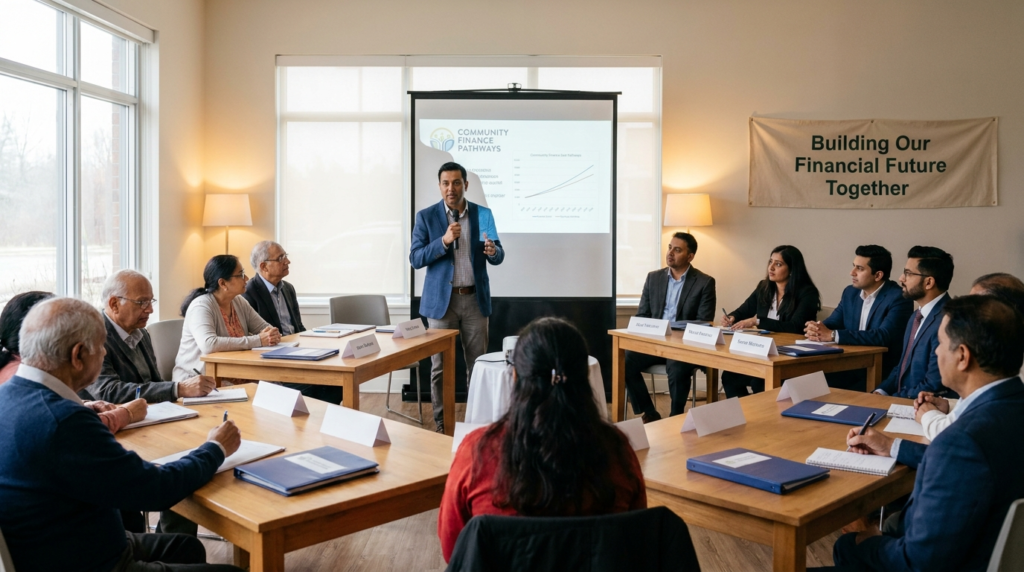
Financial literacy events are the most direct mechanism for closing the trust gap in newcomer and multicultural financial services marketing in Canada. Specifically, an in-language financial education event does something media advertising cannot: it earns the room before it makes the ask.
Indeed, the format works because it inverts the standard financial marketing dynamic. Generally, financial brands approach multicultural consumers as an audience to be persuaded. A financial literacy event positions the brand as a resource for a community that needs one. Consequently, the result is a radically different consumer disposition. Indeed, attendees who receive genuinely useful financial guidance in their own language do not just remember the brand. They trust it.
Moreover, the social dynamics of immigrant communities amplify this effect. South Asian community members who attend a Punjabi-language mortgage workshop at a Brampton gurdwara will recommend that brand to family members, neighbours, and community friends. East Asian community members who receive Mandarin-language TFSA guidance at a Markham community association event bring that experience back to their immediate social networks. Specifically, the word-of-mouth compounding rate in tight immigrant networks is one of the structural reasons in-person financial literacy events outperform digital advertising for multicultural acquisition.
Additionally, financial literacy events generate qualified lead pools. Attendees who show up to understand Canadian mortgages, investment accounts, or insurance products have already self-selected as active financial decision-makers. Accordingly, the conversion rate from in-person literacy event attendees to product inquiries is structurally higher than cold digital acquisition.
For more on how Brand Guruz staffs and manages in-language community event programs, see our brand ambassador program guide.
Overall, the Big 5 Canadian banks have long recognized multicultural communities as a strategic priority. TD invested $1 million in 14 non-profit organizations supporting newcomer settlement and financial education in November 2025. RBC runs multicultural banking campaigns in multiple languages, targeting newcomer audiences with international money transfer and account opening products. Scotiabank created culturally adapted campaigns for Chinese-Canadian and Hispanic-Canadian audiences — designed around values of family, education, and community rather than translated from English.
Nevertheless, most Big 5 multicultural financial marketing remains media-first. Specifically, it targets multicultural audiences through advertising channels — ethnic media, digital, social — without generating the on-ground presence that closes the trust gap. Consequently, a real competitive opportunity exists for financial brands willing to move their multicultural marketing investment from broadcast to community.
Specifically, financial brands that activate at multicultural community events create a community presence that media spending cannot replicate. Consequently, a bank that sponsors a South Asian community fair in Brampton with Punjabi-speaking advisors and free consultations is not running an ad. It is building a community relationship. Furthermore, that relationship persists and compounds in ways that an awareness campaign does not.
For financial brands not yet running community event programs, the festival activation model offers a structured entry point. See our festival brand activation guide for how community event activations work in practice across Ontario’s multicultural festival calendar.
Indeed, language is the primary barrier to financial trust for newcomers across every multicultural community in Canada. Specifically, this is not simply about translation. It is about cultural fluency — explaining a TFSA contribution room reset in terms that map onto a consumer’s existing financial worldview.
Specifically, in-language brand ambassador programs for financial services are more complex to design than equivalent programs for consumer goods. Financial products are regulated. Moreover, advisors and representatives operating at community events must operate within applicable compliance frameworks. In-language financial ambassadors also need substantive product training, not just language fluency. The ambassador who explains in Tagalog how a FHSA compares to an RRSP is far more valuable than one who only distributes brochures.
Brand Guruz manages the full financial services ambassador program chain: community recruitment, product knowledge training, compliance briefing, and community event deployment. Our in-language capability covers Punjabi, Hindi, Tamil, Tagalog, Cantonese, and Mandarin. These are the primary languages of the GTA’s South Asian, Filipino, and East Asian newcomer communities.
For the community-level research methodology that should inform the ambassador program design, our multicultural market research guide covers how Brand Guruz approaches this.
Overall, fintech challengers occupy a structurally interesting position in multicultural financial services marketing in Canada. Wealthsimple, EQ Bank, Questrade, and Wise often carry product advantages over Big 5 banks for newcomers — lower fees and faster international transfers. However, they carry a trust disadvantage. They lack the institutional brand recognition that immigrant communities default to when making high-stakes financial decisions.
Consequently, fintech brands face an acquisition challenge in multicultural Canada that advertising alone cannot solve. Specifically, a Wise ad on a South Asian podcast reaches an audience that may rationally prefer the product. Yet many will still open their first Canadian account at a TD branch. A branch is physical proof of institutional permanence.
Overall, community event activation is the mechanism through which fintech brands close that credibility gap in multicultural Canada. A Wealthsimple advisor at a Brampton financial literacy event, answering Punjabi-language investment questions, creates physical institutional presence that digital marketing cannot manufacture. Similarly, a Questrade representative at a Filipino community fair in Scarborough builds face-to-face credibility that accelerates the digital trust transfer.
For fintech brands, the financial services marketing activation model in multicultural Canada follows a clear structure. Build in-person trust at community events. Use that trust foundation to drive digital account opening conversions. The experiential marketing company Toronto framework we use scales across both Big 5 banks and fintech challengers.
What makes financial services marketing in Canada different from other categories? The trust barrier is higher in financial services than in almost any other category. In multicultural and newcomer communities, that barrier is compounded by unfamiliarity with Canadian financial regulations and historically negative experiences with institutions. Financial services marketing in Canada that succeeds does so by closing the knowledge gap — through community events, in-language advisory, and on-ground presence.
Do financial literacy events actually convert multicultural consumers into customers? Yes — and at rates that outperform cold digital acquisition. Attendees have already demonstrated active financial intent. Moreover, the trust transferred through in-person guidance from a culturally fluent advisor closes the conversion distance in ways digital advertising cannot.
How does Brand Guruz approach compliance in financial services ambassador programs? Financial services ambassador programs operate within compliance frameworks set by OSFI and applicable FSRA guidelines. Brand Guruz works with clients to define the scope of ambassador communications — distinguishing educational activity from licensed advisory activity — before deployment.
Which multicultural communities are the biggest opportunity for financial brands in Canada? South Asian-Canadian communities — concentrated in Brampton, Mississauga, and Markham — represent the largest single multicultural financial opportunity in Ontario. East Asian-Canadian communities in Markham and Richmond Hill are the second-largest cluster. Caribbean-Canadian and Filipino-Canadian communities represent additional major opportunities.
Does Brand Guruz work with banks, credit unions, and fintech brands on financial services marketing in Canada? Yes. Brand Guruz designs and runs multicultural financial services marketing programs for banks, credit unions, and fintech brands across Ontario. Programs cover literacy event production, in-language ambassador staffing, and community festival activations — each designed around the brand’s acquisition objectives and target communities.

Talk to Brand Guruz about financial services marketing in Canada — in-language financial literacy events, multicultural community ambassador programs, and festival activation planning across Ontario’s South Asian, Caribbean, East Asian, and Filipino communities.