The Korean Canadian Consumer: A 2026 Guide for Brand Marketers

The Korean Canadian consumer is one of the most commercially coherent multicultural audiences in the GTA — and one of the most consistently overlooked. Specifically, Statistics Canada’s 2021 Census puts the Korean Canadian population at approximately 198,000 nationally, with the GTA holding the country’s largest concentration. Moreover, the Korean Canadian consumer community punches well above its size in commercial terms. High household incomes, very high education spending, strong brand loyalties, and two distinct annual occasions all drive this outsized commercial presence.

The Korean Canadian community also spans two distinct immigration waves. Specifically, a first wave arrived from the 1970s through the 1990s. They established Koreatown on Bloor Street West and built the commercial and religious institutions that anchor Korean Canadian life today. A second, newer wave arrived through international student programs and skilled worker streams from the 2000s onward. They are younger, more K-culture connected, and more digitally active than the previous generation. Brands that treat the Korean Canadian consumer as a single demographic consistently miss the meaningful commercial differences between these two cohorts.

This guide covers the Korean Canadian consumer’s community geography, spending priorities, cultural occasions, and brand activation approach. For companion profiles in this series, see our Chinese Canadian consumer guide and Filipino Canadian consumer guide. The full 2026 cultural occasions overview is in our Canadian multicultural events calendar.

~198,000

Korean Canadians in the 2021 Census, with the GTA holding the largest national concentration (Statistics Canada)

Two

distinct annual occasions where Korean Canadian consumer spending peaks: Seollal in February and Chuseok in late September

North York

 the primary Korean Canadian commercial corridor in the GTA, distinct from and significantly larger than downtown Koreatown

The Korean Canadian consumer: community size, geography, and GTA concentration

Geographically, the Korean Canadian consumer community clusters in the GTA across two distinct expressions. Specifically, Koreatown along Bloor Street West at Christie is the historic cultural district — dense with Korean restaurants, grocery stores, and cultural businesses. It is the area most visible to the general public. The North York corridor, anchored around Yonge and Sheppard, is larger and more commercially developed. It represents the primary everyday shopping and community hub for Korean Canadian consumers across the GTA.

Additionally, Thornhill — spanning the Vaughan and Markham boundary north of Toronto — holds a significant Korean Canadian residential and church community. Specifically, many of the GTA’s large Korean Protestant churches operate in Thornhill, drawing congregations from across the northern GTA. Mississauga and Markham also carry growing Korean Canadian populations. Together these corridors form the primary Korean Canadian consumer activation footprint for brands operating in the GTA.

The community spans two generations with meaningfully different consumer behaviours. Specifically, first-wave Korean Canadians — now often parents and grandparents — maintain strong loyalty to Korean grocery stores, Korean-language church communities, and established Korean brands. Second-wave Korean Canadians are more K-culture fluent and more active on KakaoTalk and Korean YouTube channels. They respond more strongly to brands that understand the current Korean cultural moment. Effective Korean Canadian consumer marketing addresses both groups with distinct targeting rather than a single generational approach.

Korean Canadian consumer spending: priorities, occasions, and category behaviour

Education commands a higher share of Korean Canadian household spending than almost any other community in Canada. Specifically, hagwons — private tutoring academies for supplementary academic instruction — are a near-universal Korean Canadian family expenditure. Korean Canadian parents invest heavily in tutoring, SAT and LSAT preparation, university application coaching, and enrichment programs across multiple subject areas. Brands in the education services, stationery, and technology sectors find loyal Korean Canadian consumer audiences.

Food and grocery spending reflects deep cultural identity. Specifically, H-mart and Galleria Supermarket are the primary Korean Canadian grocery destinations in the GTA. They stock Korean staples from gochujang and doenjang to fresh kimchi, tteok, japchae noodles, and premium Korean snack products. Google Canada research confirms that multicultural consumers over-index on peer recommendations within trusted community retail environments. Korean BBQ dining represents a social occasion rather than a quick meal, generating significant restaurant spending. Brands in the food, grocery, and dining categories find that the Korean Canadian consumer is an intensely loyal audience once trust is established.

K-beauty is a third major spending category with distinctive characteristics. Specifically, Korean skincare — sheet masks, essences, serums, and BB creams — carries strong community endorsement among Korean Canadian consumers of all ages. Additionally, electronics spending reflects strong brand loyalties to Samsung and LG. Automotive spending shows similar community preference patterns toward Hyundai and Kia. Financial services brands that reach Korean Canadian consumers early — especially through church community channels and Seollal-season messaging — earn durable financial product loyalty. See our multicultural market research guide for the community context.

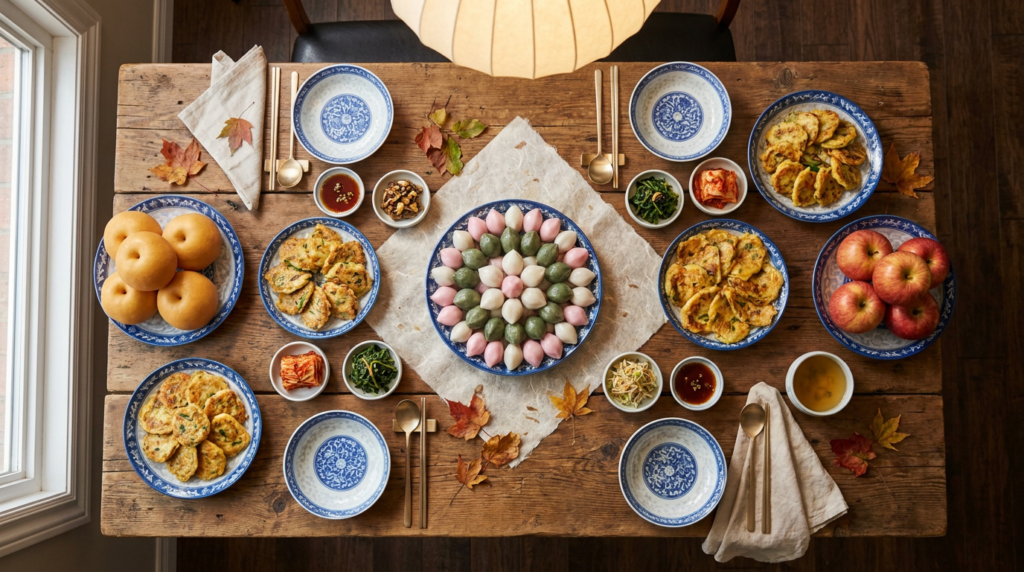
Korean Canadian consumer 2026: a Chuseok table spread with songpyeon rice cakes, jeon, stacked fruit, and traditional ceramic dishes at a Toronto Korean Canadian home.
Chuseok — Korean Thanksgiving — falls in late September 2026. The Chuseok table spread of songpyeon, jeon, and stacked fruit is as central to Korean Canadian family life as Christmas dinner is to mainstream Canadian households. Premium food, gift hamper, and health supplement brands all peak at Chuseok.

The cultural occasions that shape Korean Canadian consumer decisions

Seollal — Korean Lunar New Year — falls on February 17, 2026, the same date as Chinese Lunar New Year. It is the most significant family occasion in the Korean Canadian consumer calendar. Specifically, family reunions, ancestral rites, and the eating of tteokguk (rice cake soup) mark the day. Sebae — the formal deep bow from younger family members to elders — generates sebae-don, the gift money given to children in response. The sebae-don tradition makes Seollal a natural activation moment for financial services brands, gift product brands, and food retailers.

Chuseok — the Korean harvest festival and the closest cultural equivalent to Thanksgiving — falls in late September 2026. Specifically, Chuseok generates the second-highest Korean Canadian consumer spending concentration of the year. Families reunite, share songpyeon rice cakes, perform charye (ancestral memorial rites), and exchange premium gifts. Gift hampers of premium Korean health supplements, packaged goods, and specialty foods drive significant Chuseok consumer spending. Additionally, Korean Canadian consumers purchasing Chuseok gifts prioritise quality over price in ways that create opportunity for premium brand positioning.

Furthermore, Korean Christmas carries deep significance. The majority of Korean Canadians are Protestant Christian, and Christmas represents both a religious and family occasion with very high gifting and dining activity. Specifically, Korean Canadian consumers index high on premium food, electronics, and educational product gifting at Christmas. Brands that acknowledge Seollal, Chuseok, and Christmas build three annual touchpoints that compound into year-round Korean Canadian community trust. For the broader cultural occasions context, see our Canadian multicultural events calendar.


What brands get wrong about Korean Canadian consumer marketing

The most common mistake is treating Korean Canadian marketing as identical to Chinese Canadian marketing. Specifically, both are East Asian communities — but they observe different occasions, speak different languages, use different platforms, and hold distinct cultural references. Seollal and Chuseok are Korean; Lunar New Year and Chuseok coincide calendrically but are observed with different traditions. Creative that works for the Chinese Canadian consumer does not automatically translate to the Korean Canadian consumer.

The second mistake is ignoring Korean Protestant church communities as activation channels. Specifically, Korean churches in North York, Thornhill, and Mississauga function as the primary community trust institution for first-wave Korean Canadian families. Church bazaars, community events, and church directory advertising are among the highest-trust brand touchpoints in the Korean Canadian community — and almost no brands use them.

The third mistake is underestimating KakaoTalk. Specifically, KakaoTalk is the dominant messaging and peer-recommendation platform for Korean Canadians — not WeChat, not WhatsApp. Community group chats on KakaoTalk spread brand reviews, product recommendations, and promotional content at high velocity. A Korean Canadian consumer marketing strategy without a KakaoTalk-aware digital approach misses the community’s primary information-sharing channel.

Finally, brands frequently overlook the generational split. Specifically, a Seollal campaign featuring traditional imagery may resonate strongly with first-wave Korean Canadian families. It often feels disconnected from second-wave consumers who grew up watching K-dramas and Korean YouTube creators. Effective Korean Canadian consumer marketing segments by generation as much as by cultural occasion. See our multicultural brand ambassador guide for the in-community activation model.

How to reach Korean Canadian consumers through experiential marketing

The Korean Canadian consumer responds most strongly to in-community presence within the North York commercial corridor, Koreatown, and Korean church community contexts. Specifically, activations at Seollal community events, Chuseok gatherings, and Korean church bazaars reach Korean Canadian consumers within the environments where peer trust naturally flows.

The Edelman Trust Barometer consistently shows that community trust builds through authentic in-community presence. Korean Canadian community members must be on every activation ambassador team. Specifically, Korean-language fluency is non-negotiable — and the generational character of the ambassador team should reflect the target cohort. A Korean-speaking ambassador from a Korean Canadian church background speaks to first-wave consumers in a fundamentally different register. Younger K-culture-fluent Korean Canadian ambassadors reach the second wave more effectively.

Additionally, premium gifting formats perform well at both Seollal and Chuseok. Specifically, brands that offer branded gift sets and limited-edition Seollal packaging in red and gold create natural purchase occasions. Premium hamper formats for Chuseok align equally well with that occasion’s gifting traditions. Furthermore, H-mart and Galleria Supermarket partnerships for in-store activations reach Korean Canadian consumers within their most trusted retail environments.

For the full experiential activation framework, see our festival brand activation playbook, brand ambassador program guide, and experiential marketing agency Toronto overview.

Frequently asked questions about the Korean Canadian consumer

How large is the Korean Canadian consumer community in the GTA? Statistics Canada’s 2021 Census puts the Korean Canadian population at approximately 198,000 nationally. The GTA holds the largest concentration, anchored in North York, Koreatown, Thornhill, and growing communities in Mississauga and Markham.

What are the most important brand activation occasions for Korean Canadian consumers? Seollal (February 17, 2026) and Chuseok (late September 2026) are the two peak occasions. It drives food, gifting, and financial services spending. Chuseok drives premium gift hamper, health supplement, and food spending. Christmas is the third significant spending occasion for the majority-Christian Korean Canadian community.

How is KakaoTalk used in Korean Canadian consumer marketing? KakaoTalk is the dominant community messaging platform for Korean Canadians. It is the equivalent of WeChat for Mainland Chinese Canadians and WhatsApp for South Asian Canadians. Community group chats spread brand content, peer reviews, and promotions at high velocity. Korean Canadian consumer marketing without a KakaoTalk-aware strategy misses the primary peer-recommendation channel in this community.

What spending categories perform best with the Korean Canadian consumer? Education, food and grocery, K-beauty and personal care, electronics, automotive, and financial services all perform strongly. Specifically, hagwon and tutoring investment is proportionally higher among Korean Canadian families than almost any other community in Canada.

How should brands approach the generational split in the Korean Canadian community? First-wave Korean Canadian consumers respond most strongly to traditional cultural imagery, Korean-language communication, and church community channels. Second-wave Korean Canadians and younger Korean Canadians respond more to K-culture references, Korean creator content, and KakaoTalk-native brand engagement. Effective Korean Canadian consumer marketing segments these two cohorts rather than addressing them as one audience.

Reach Korean Canadian consumers across the GTA with Brand Guruz

Talk to Brand Guruz about building a Korean Canadian consumer activation program across the GTA. We cover Seollal, Chuseok, and year-round community presence with in-language Korean ambassador teams across North York, Koreatown, and Thornhill.

Author