The Filipino Canadian Consumer: A 2026 Guide for Brand Marketers

The Filipino Canadian consumer stands out in the Canadian multicultural landscape for reasons that consistently catch brand marketers off guard. Specifically, Filipino Canadians numbered over 957,000 in the 2021 Census — one of the fastest-growing diaspora communities in Canada. Furthermore, the Philippines ranks consistently among Canada’s top five source countries for permanent residents. That pipeline drives ongoing community growth year over year. Consequently, this consumer pool grows larger with each immigration cycle. Each cycle adds commercially significant newcomer households to an established, economically active community.

What makes this community distinct is not just size — it is cultural character. Specifically, the Filipino Canadian community organizes its social and consumer life around two dominant forces: Catholic faith and family. These two forces shape what Filipino Canadian consumers buy, when they buy it, and which brands they trust. Brands that understand this cultural architecture activate with authenticity. Those that treat this community as simply another multicultural audience leave significant opportunity untapped.

This guide covers the community size, spending priorities, cultural occasions, and brand activation approach for this community in 2026. For the broader multicultural consumer series, see our Chinese Canadian consumer guide, Caribbean Canadian consumer guide, and South Asian consumer Canada guide.

957,000+

Filipino Canadians in 2021, one of Canada’s fastest-growing diaspora communities (Statistics Canada)

Top 5

Philippines consistently ranks among Canada’s top five permanent resident source countries

September

when the Filipino Canadian Christmas season begins, giving brands a 4-month consumer activation window unlike any other in the multicultural calendar

The Filipino Canadian consumer: community size, geography, and GTA concentration

Filipino Canadians concentrate in the GTA in numbers that give the community genuine commercial scale. Specifically, Mississauga holds the largest Filipino Canadian population in the GTA, with significant communities also in Brampton, east Toronto, and North York. Additionally, Winnipeg carries one of the highest Filipino populations relative to overall city size in Canada. This community extends meaningfully beyond the GTA.

Furthermore, the Filipino Canadian community in Canada spans two distinct migration streams. Specifically, many first-generation Filipino Canadians arrived through Canada’s caregiver programs. They built strong professional roots in healthcare, elder care, and domestic services. A second, newer wave arrived through the Express Entry system and provincial nominee streams, bringing skilled workers, professionals, and entrepreneurs into the GTA economy. Both streams contribute to a community that indexes high on employment stability, household income growth, and consumer spending capacity.

Moreover, Filipino Canadian community life organizes around barangay-style social networks — tight local sub-communities connected through church parishes, sports leagues, and cultural associations. Specifically, St. Joseph the Worker Parish in Mississauga, and Catholic parishes across Brampton and Scarborough, serve as anchor institutions that structure Filipino Canadian social life. These parish networks function as trusted peer-recommendation systems — a fact that matters deeply to brand marketers seeking authentic community access.


Filipino Canadian consumer spending: priorities, occasions, and category behaviour

The Filipino Canadian consumer directs significant spending toward food, remittances, communications, and celebration. Specifically, remittances to the Philippines represent one of the most consistent and significant financial outflows in the Filipino Canadian household. The Philippines ranks among the world’s largest remittance-receiving countries. Community members use money transfer services at high rates throughout the year. Financial services, banking, and remittance brands with strong Filipino Canadian community positioning capture loyal, high-frequency users.

Food spending reflects deep cultural identity. Specifically, Filipino grocery stores and restaurants across Mississauga, Brampton, and east Toronto serve communities that seek lechon, adobo ingredients, halo-halo supplies, and pancit noodles. Jollibee — the Philippine fast food chain — draws some of the GTA’s longest quick-service restaurant lineups. Filipino Canadian consumers hold intense emotional loyalty to home-country food brands. CPG and food brands that earn a place in Filipino Canadian kitchens earn durable, word-of-mouth-driven loyalty.

Additionally, telecommunications and mobile spending ranks high. Specifically, this community ranks among the most active social media communities in Canada. Facebook functions as its dominant communication and community platform. IRCC immigration data consistently shows the Philippines as a top source country. Filipino Canadian newcomers arrive with strong mobile habits and peer networks that extend quickly into the GTA community. Furthermore, celebration and event spending — for fiestas, Pasko (Christmas), and community gatherings — adds significant seasonal spending activity.

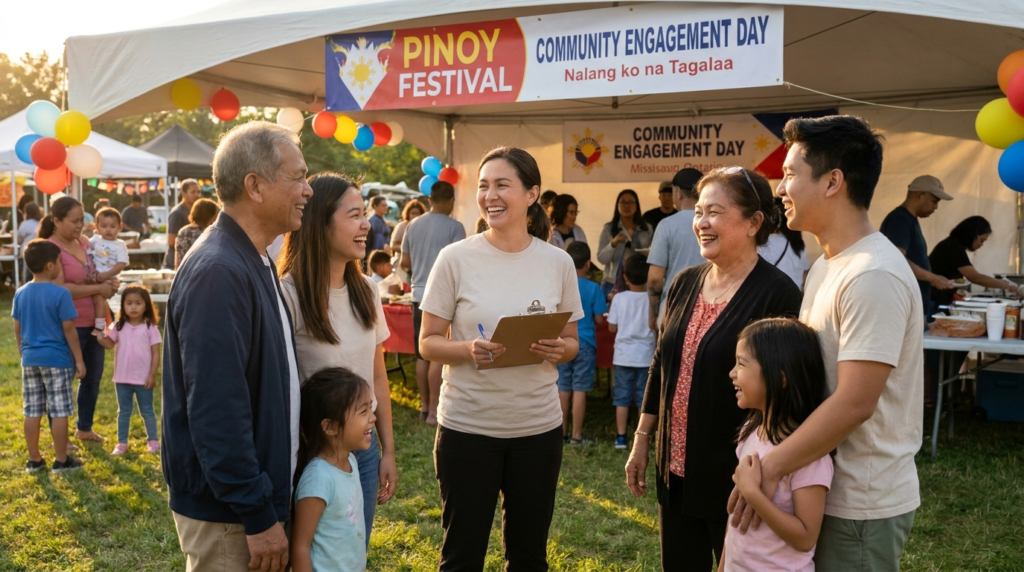
Filipino Canadian consumer 2026: brand ambassadors engaging warmly with Filipino Canadian families at a community cultural activation in Mississauga, Ontario.
Reaching the Filipino Canadian consumer requires authentic community presence — in Mississauga, Brampton, and east Toronto — built around the community's Catholic faith, family structure, and uniquely long Christmas season.

The cultural occasions that shape Filipino Canadian consumer decisions

The Filipino Canadian consumer calendar runs longer than virtually any other multicultural community calendar in Canada. Specifically, Christmas — called Pasko in Filipino culture — begins in September. The “ber months” (September, October, November, December) mark four consecutive months of heightened Christmas spending, social activity, and community celebration. Brands that treat the community’s Christmas season as starting in November miss two full months of the activation window.

Additionally, Philippine Independence Day on June 12 generates significant community pride events and consumer spending across Mississauga and Brampton. Specifically, Filipino Heritage Month in June — officially recognized in Ontario — provides a month-long window for community-oriented brand activations. Cultural identity and media coverage both elevate across the month.

Furthermore, Holy Week and Easter hold deep significance in the Filipino Canadian community. Specifically, the Philippines is among the most Catholic nations on Earth. Filipino Canadians maintain strong Easter observance through church services, family gatherings, and traditional holiday foods. Good Friday and Easter Sunday activations that acknowledge this faith dimension earn strong community goodwill. Additionally, the Feast of the Santo Niño in January and Flores de Mayo in May add further cultural occasions. Together they reward brands that engage year-round. For the full 2026 multicultural occasions overview, see our Canadian multicultural events calendar.

What brands get wrong about Filipino Canadian consumer marketing

The most common error brands make is ignoring the Filipino Canadian consumer entirely while pursuing South Asian, Chinese, and Caribbean Canadian audiences. Specifically, this community at nearly one million Canadians carries more commercial scale than many brands realize. Additionally, the community’s high rate of consumer spending on food, celebrations, and telecommunications makes it a high-value multicultural audience across multiple categories.

The second error is treating the Filipino Canadian consumer as a monolingual, monolithic audience. Specifically, while Tagalog is the dominant Filipino language in Canada, the Filipino community includes speakers of Cebuano, Ilocano, Kapampangan, and other regional languages. Additionally, many Filipino Canadians are bilingual or trilingual — English-dominant, with varying fluency in Tagalog and regional dialects. In-language marketing works — but it works best when the language choice shows genuine community knowledge rather than generic Filipino-language content.

The third error involves ignoring faith. Specifically, Catholic identity runs deep in the Filipino Canadian consumer community. It shapes purchasing decisions, community trust signals, and brand relationships in ways brands rarely account for. Brands that partner with Filipino Canadian parish communities or acknowledge Catholic cultural occasions earn a depth of trust that mass media cannot replicate. See our multicultural brand ambassador guide and brand ambassador program guide for the community activation model.

How to reach Filipino Canadian consumers through experiential marketing

The Filipino Canadian consumer responds most strongly to community presence built through parish networks, barangay-style community organizations, and cultural events. Specifically, the Edelman Trust Barometer confirms that community-oriented audiences build brand trust primarily through peer networks and consistent in-community presence. Filipino Canadian consumer trust operates through exactly these channels — parish bulletins, community Facebook groups, and word of mouth within barangay-style social circles.

Specifically, Facebook stands as the primary platform for Filipino Canadian consumer community communication in Canada. Brand content, event announcements, and peer reviews spread through Filipino Canadian Facebook groups at high velocity. Additionally, YouTube carries significant weight for Filipino Canadian media consumption. Community creators and Tagalog-language content reach high-engagement Filipino Canadian audiences across the GTA.

Moreover, in-person brand presence at Filipino Canadian community events drives strong engagement. Specifically, fiesta-style community gatherings, parish fundraisers, and Pasko celebrations all provide opportunities to meet Filipino Canadian consumers within trusted community contexts. For the full experiential activation approach, see our festival brand activation playbook and experiential marketing agency Toronto guide.

Frequently asked questions about the Filipino Canadian consumer

How large is the Filipino Canadian consumer community in the GTA? Filipino Canadians number over 957,000 nationally, with Mississauga holding the largest single GTA concentration. Specifically, Brampton, east Toronto, and North York also carry significant Filipino Canadian consumer populations.

What is the most important brand activation occasion for Filipino Canadian consumers? Pasko — the Filipino Christmas season — runs from September through December, giving brands a four-month consumer activation window unique in the Canadian multicultural calendar. Filipino Canadian consumer spending on food, gifts, and social events runs high across all four months. Philippine Independence Day in June and Filipino Heritage Month across June are the most significant secondary activation occasions.

How does Catholic faith influence Filipino Canadian consumer behaviour? Catholic identity shapes Filipino Canadian consumer trust, social organization, and purchasing decisions in ways most brands underestimate. Specifically, parish communities function as trusted peer networks. Brand relationships built through church events carry higher trust than those built through broadcast advertising.

What spending categories perform best with the Filipino Canadian consumer? Food and grocery, remittance and financial services, telecommunications, personal care, and celebration spending all perform strongly. Specifically, remittances to the Philippines represent a very consistent high-frequency financial services use case across the Filipino Canadian consumer community.

How should brands staff a Filipino Canadian consumer activation? The brand ambassador team should include Filipino Canadian community members who reflect the specific regional and linguistic diversity of the target community. Specifically, Tagalog-speaking ambassadors form the core of any Filipino Canadian consumer activation. Additionally, parish community partnerships and recognized community organization endorsements amplify ambassador credibility within the tight-knit Filipino Canadian community social network.

Reach Filipino Canadian consumers across the GTA with Brand Guruz

Talk to Brand Guruz about building a Filipino Canadian consumer activation program across the GTA. We cover Pasko, Philippine Independence Day, and Filipino Heritage Month activations. In-community Tagalog-speaking ambassador teams operate across Mississauga, Brampton, and east Toronto.

Author